
- Home
- Blog
- Digital Marketing
- Google Is Dead, It’s All AI Now.” Why AI Still Depends on Google
Digital Marketing
Google Is Dead, It’s All AI Now.” Why AI Still Depends on Google
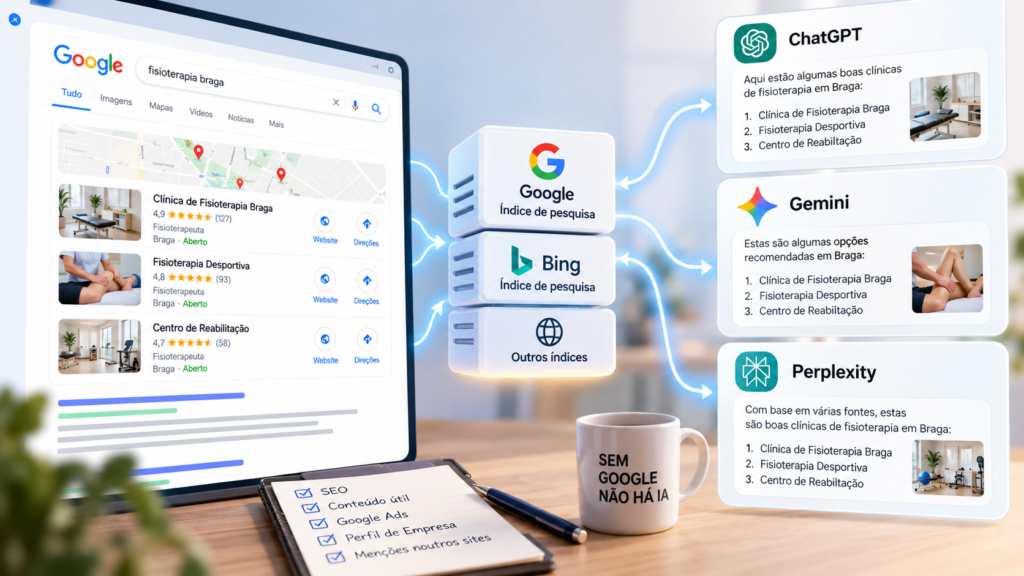
ChatGPT, Gemini and Google’s AI Overviews don’t make up the businesses they recommend. When they answer a question about a service, a product or a local business, they search the web first, and that search goes through search engines: Google’s index, Bing’s index and their own. A business that doesn’t show up in those engines is unlikely to show up in an AI answer. Dropping SEO and Google campaigns to “go all in on AI” means cutting off the very source AI draws from.
Where the idea that Google no longer matters comes from
The idea isn’t baseless. More and more people ask ChatGPT or Gemini directly, and Google itself now shows AI-generated answers at the top of the page. There are fewer clicks on traditional results and more ready-made answers.
The mistake is in the conclusion. People searching differently doesn’t mean Google stopped counting. It means the way to appear there has changed.
How AI chooses which businesses to recommend
When someone asks “what’s a good physiotherapy clinic in Braga?”, the AI assistant doesn’t have that answer stored in memory. It runs several web searches, reads a few pages and summarises what it found into two or three names.
Those searches rely on search engines:
- Gemini and AI Overviews use Google’s index. If Google doesn’t know a page, Google’s AI doesn’t either.
- ChatGPT uses its own index plus several external providers, including Bing and Google results. For local businesses, it also uses data from Google Maps, Yelp and TripAdvisor.
- Perplexity and Copilot work in a similar way: they search first, answer second.
A simple test shows it. The analytics company Peec took a website with no organic traffic, asked only ChatGPT about it, and saw visits to that site appear in Google Search Console on those same days. ChatGPT was querying Google to build its answer.
“But AI cites pages that aren’t in the top 10”
True, and it’s worth understanding why. A 2026 Ahrefs study found that only 38% of pages cited in AI Overviews rank in Google’s top 10 for the exact query. In 2025 the figure was 76%.
That doesn’t mean Google stopped counting. It means AI runs several searches for every question (on prices, location, reviews, alternatives) and combines the results. A page might not rank first for “physiotherapy Braga” but rank well for “how much does a physiotherapy session cost” or “sports physiotherapy Lamaçães”. It’s still being found through search.
What changes is that one well-ranked page is no longer enough. The winners are those who cover a topic well, from several angles, with clear and up-to-date content.
What about Google Ads?
Campaigns still make sense too, for three reasons:
- Many people still search Google with buying intent. Someone typing “emergency electrician Braga” doesn’t want a conversation, they want a phone number.
- The AI conversation often ends on Google. People ask ChatGPT for suggestions, end up with two names, then search them on Google to check reviews, website and contact details. If a competitor shows up in an ad at that moment, the customer may change their mind.
- Campaigns produce data. They show which searches convert, which services people want and which messages work. That information then feeds the content AI will read.
We explain how SEO and ads complement each other in Google Ads and SEO don’t compete — they work different shifts.
What to do in practice
- Make sure your site is indexed on Google and Bing. Connect Google Search Console and Bing Webmaster Tools and confirm your key pages appear.
- Don’t block AI crawlers. Check that your robots.txt file allows crawlers such as OAI-SearchBot (ChatGPT) and Googlebot.
- Keep your Google Business Profile complete. It’s where many AI tools get their data on local businesses.
- Write to answer, not to impress. Clear sentences on who you are, what you do, where, at what price and for whom.
- Cover the topic from several angles. One page per service, FAQs, comparisons, real cases.
- Get mentioned elsewhere. Press, directories, partners, YouTube. AI trusts businesses that others also mention.
- Measure. Know how many leads come from Google, from campaigns and from visits referred by chatgpt.com. See Before investing in ads, set up your tracking.
We go deeper into the AI side in GEO: how to get your brand into AI answers.
Frequently asked questions
Is SEO still worth investing in now that AI is here?
Yes. AI searches the web through search engines before answering. A well-ranked, well-structured website has a much better chance of being found and cited.
If I rank in Google’s top 10, will I automatically appear in ChatGPT?
Not automatically. Ranking well greatly increases your chances, but AI also values clarity, freshness and mentions on other websites.
Does ChatGPT use Google or Bing?
Both, plus its own index. For local businesses, it also uses map data and review platforms.
Should I stop running Google Ads and move the budget to AI?
For now, there’s no widespread way to “buy” a place in ChatGPT’s answers. Google campaigns still capture people searching with buying intent, including those who arrive there after talking to an AI.
How do I know if my business shows up in AI?
Ask ChatGPT, Gemini and Perplexity the questions your customers would ask, including your service and your city. Then compare with what Google shows for the same searches.
Conclusion
AI has changed how people find businesses, but it hasn’t changed where AI goes looking for information. Those who switch off SEO and campaigns to “bet on AI” become invisible in both places at once.
If you’re not sure where to start, the free COSMOS diagnosis shows you in one minute the specific areas to work on. If you’d rather talk now, our WhatsApp replies in under an hour.
SEO plugin fields:
- Meta title: Has AI Replaced Google? Why SEO Still Matters | COSMOS
- Meta description: ChatGPT and Gemini pull their answers from search engines. Learn why there’s no AI visibility without Google, and what to do to appear in both.
- Slug: has-ai-replaced-google-seo-still-matters
- Focus keyword: SEO and AI
- Category: Digital Marketing
Written by the COSMOS team
Up next
More notes from the team

Google Ads and SEO don’t compete — they work different shifts
Ads buy attention now; SEO earns it over months. Pitting them against each other for the same budget is the quickest way…